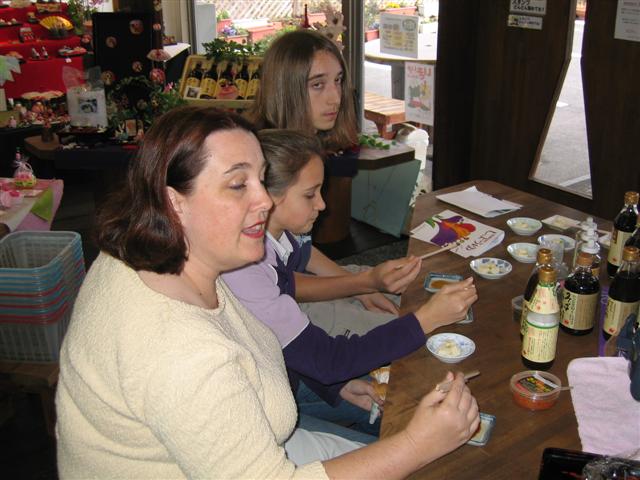
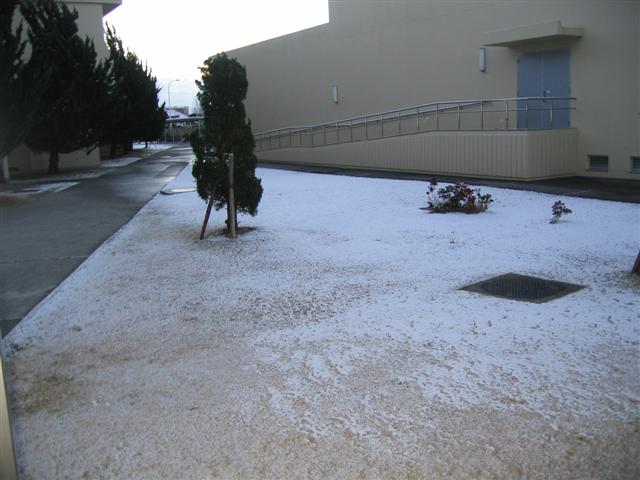
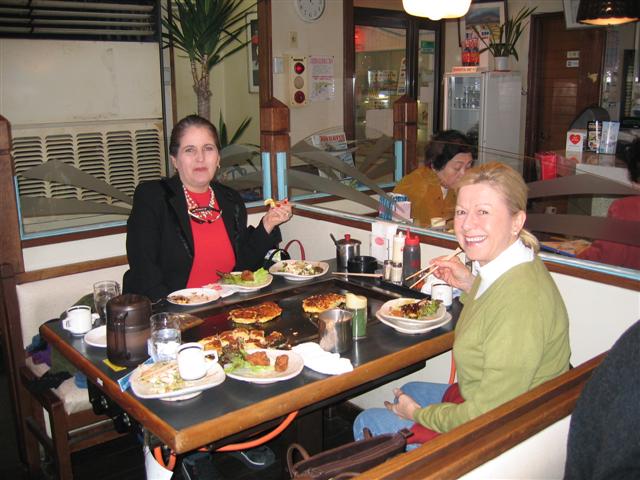
Thu 1/20 I had lunch with Ingrid, Paulette and Amelia at a beautiful Korean restaurant. In the beautiful wooden entry, we removed our shoes, and I saw a small sink (one of the modern ones that look like a bowl sitting on a counter) where you could wash your hands. As we walked toward the booths, I noticed that the tables were low – Japanese-style, and I was afraid I would have to kneel (which is almost impossible with my knees! or sit with them stretched out in my across-the-table-neighbor’s lap!) Fortunately, the floors under the table were also low, so you stepped down and sat well below the table on the bench seating. There was a small gas grill built right into the middle of the table and after enjoying our fresh salad, we were served a bowl with large chunks of raw beef and fresh chopped cabbage, which we cooked on the grill. We were also provided a small bowl of kimchi (A Korean dish made of vegetables, such as cabbage or radishes, that are salted, seasoned, and stored in sealed containers to undergo lactic acid fermentation -- which is a little too spicy for me) and several dipping sauces. Paulette, who has lived in Japan for 18 years, explained the sauces and ordered an ala carte plate with several sheets of green leaf lettuce & showed us how to make a little “burrito” with the cooked meat, sauce & cabbage wrapped inside the lettuce leaf. And of course we drank lots of hot green tea which is usually served as soon as you sit down. When we walked outside – a little snow was falling but the sun was shining brightly. We went to the 100 yen store (I’m not kidding!) and I found some items I needed for my class and some slippers. The 100 yen store is WAY better than the dollar store, and the best place to find what you’re looking for – kind of makes me miss Wal-Mart a little less . . .
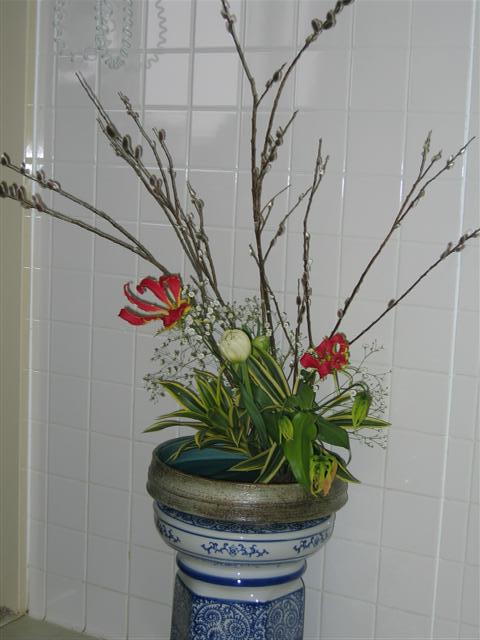
Mon 1/24 Ikebana – Japanese flower arranging class. Again, I wasn’t sure if this is what I wanted to do, but I had a great time & came home with a beautiful floral arrangement. Of course, the instructor (sensei) mostly did mine this time, but I learned a lot, and when I was brave enough to cut & place my own flowers, she didn’t take them out & make me do them over. Like everything else in Japan, there are specific rules about arranging flowers and instructors study for years to do it properly. There are many different styles, but we started off with a simple traditional style. You pick a ceramic container that will hold water & the more open it is, the better. Then you use one of the old-fashioned frogs that are made up of many sharp, pointy things sticking up out of a heavy base. The flowers we were provided were in two groups – one was long woody branches (we either had pussywillow or forsythia) and another bunch of soft flowers (lilies and double-tulips). The first wood branch is cut no more than 2 times the width of the container and placed at a 10% angle (never straight up). I can’t remember it all – I’ve ordered a book, but the first 3 pieces have specific Japanese names and are placed in the shape of a triangle onto the frog, and then the soft flowers arranged around that in a similar fashion. Then we filled in with baby’s breath and some full greenery cut very short. (I’m not sure what it was). In Japan, less is always more, so the arrangements are usually quite sparse, but very artistic. It’s all about beauty, harmony, and balance and I learned that when placing the flowers, you don’t want them “bowing” toward the front, so they are turned over so that they curl up a little.
My search for just the right ikebana bowl is another story and we searched in every thrift store and shop we could find. (Vicky Roberts would have LOVED shopping here!) I didn’t want to pay a lot since I was just starting out. One of the places we shop is called “The Van Man” because he rents a little driveway in front of a shop 3 days a week outside the gate to the base and sets up a table. He & his assistant (whom I assume his wife) then begin to unload their van full of boxes and display them. I’ve bought several items from him, including a small dragonfly lamp, and a couple of the blue & white porcelain stools (one is an elephant!) and a large fish bowl planter. He told us his mother is an ikebana teacher in Hiroshima but he did not have any containers with him that day. We also went to two different shops called the Dragonfly – I don’t know if they’re related, but I finally found one I liked for the right price in another shop (as always cold and dark) down by the river. The dish is quite large – about 12”across and 3 inches high, and VERY heavy. The outside looks like very rough pottery, but the inside looks like smooth fired ceramic & the most beautiful shade of aqua with a cracked appearance. I thought maybe it was just very old, but at class, I was told that it the inside was actually covered with a fine layer of glass & then fired so that the glass would crack. I was a little sorry it was so heavy when I was carrying it around, but after I filled it with my arrangement, I realized why. Since the wood stems are so tall, the arrangement would easily tip over if the container is not heavy. In Japan, there is always a good reason for everything . . .
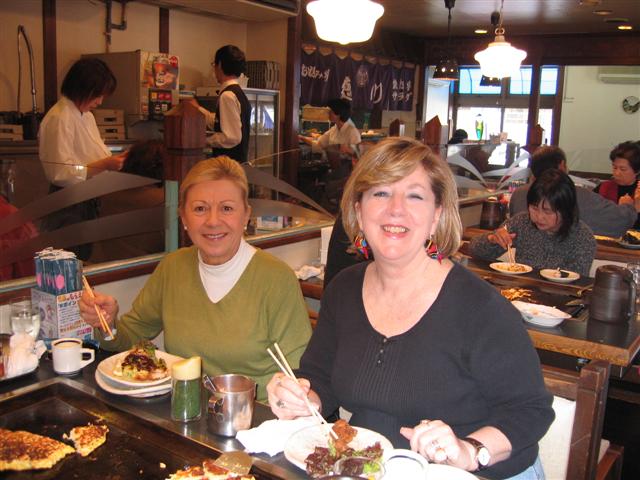
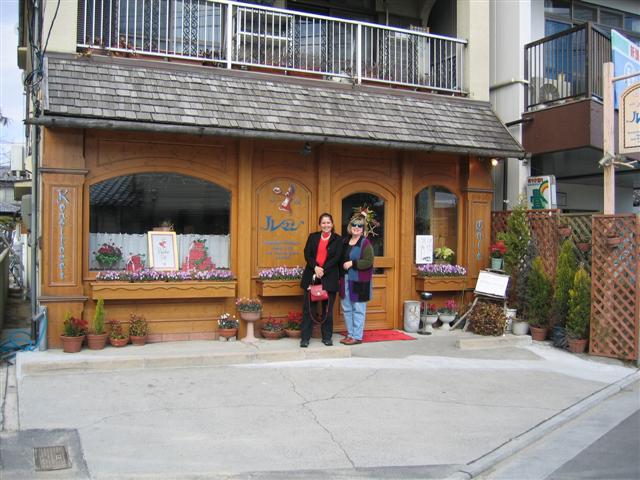
Wed 1/26 Lunch with Ingrid & Jill – We ate at another place where you cook your own food in the center of the table, but unlike the fancier place we went last week with the gas grill built into the table, this one is a small place upstairs with booths & reminded me a little of a 50s hamburger joint. Rather than a grill, the table has a large griddle built in the middle of it. We ordered a “set” (very common way to order in Japan & you get several courses.) As soon as we ordered, the griddle was turned on and we oiled it with something from a covered dish that looked like Crisco. We were then served a yummy fresh salad with the ginger dressing that I love, an appetizer of 2 small chunks of deep fried chicken arranged on a large green lettuce leaf with a lemon slice, and a small cup of sweet corn soup. Our main course was a large bowl with 2 raw eggs, a few pieces of thin-sliced pork (more like very lean bacon), a large portion of very thin-sliced cabbage and some kind of white sauce in the bottom, with a few other pieces of fresh veggies, chopped very fine. So, you stir up this mixture very well until it’s all moist – kind of like an omelet - and then pour it out onto the preheated griddle. We were furnished spatulas with which to turn our mixture. While we ate our salads and appetizer, our “omelets” cooked. Apparently, the heat is not very high, because there was very little smoke or steam coming off & the mixture did not cook too fast. When it browns on one side, you turn it over & let it cook on the other side. Then you use the spatula & cut it into bite-size portions, which are then drizzled with a white mayonnaise-type sauce, a teriyaki-type sauce and sprinkled with dried fish flakes. It was absolutely delicious and way more than I could eat. Afterward, we enjoyed coffee – the only place I’ve been in Japan that actually provided coffee with the meal along with hot tea. The best thing about the coffee is that the cream that is served is heavy cream – not even half & half and always comes in the cutest little pitcher. Plastic is very rarely used – always little ceramic bowls with lids to hold the condiments. Usually coffee is very expensive – about 400 yen ($4) per cup – and no refills. Then we started talking about coffee houses and Jill & Ingrid decided to take me to a fabulous Austrian coffee house just a few blocks away. It was a totally different atmosphere – very European and the glass cases were loaded with the most beautiful pastries, each looking more delicious than the one before. After a lot of indecision, we ordered & sat down to wait for the fresh-brewed coffee & our dessert to be delivered to our table. But when they came, the desserts had been garnished with tiny slivers of fresh fruit, decorated sauce and/or whipped cream. They were works of art and something I’ve only seen a few times before in very expensive restaurants or in magazines. It seemed a shame to dig in so I took some pictures first -- then we attacked them with gusto! What a great lunch experience and now I could go home – energized and ready to tackle more unpacking / arranging / and decorating, which seems to have become my life’s work lately . . .
Sun 1/30 Market Day at Otake – (This narrative is written by Stan. Please excuse the drop in quality) Today we went with Terry and Jerry Bymaster to a farmer’s market in Otake. What they were really selling were oysters. Otake is right on the Inland sea, and this area is famous all over Japan for its oysters. Although the park was only as large as a football field, there were many booths selling oysters cooked many different ways. Every booth had long, long lines waiting to buy the oysters. The lines were wound around and around until they were about a block long. We bought raw oysters and took them home to cook. They were wonderful. We also bought some local produce. We bought mekongs which are tangerines and are still ripening on the trees here even this late. We also bought bananas, and local honey made from orange blossoms. There was a booth selling shoes, so I went over to check out the sneakers because there were some good prices. The lady at the booth looked at me very alarmingly and stabbed her finger pointedly at the men’s section. I went to the men’s section where her husband was sitting. I showed him my foot, asked him if he had my size. We both had a good laugh at the size of my foot. We ended our outing with a meal at Zuzu’s, a very good Italian restaurant right on the water. When I say on the water, this is what I mean. As I am pulling into the parking lot, Margie is clawing her way to the driver’s (right side, remember?) side of the car because she is afraid I am going to drive off the driveway into the sea. We had been there about a week ago and Margie left her scarf there. We found the word for scarf in our phrase book and sure enough, when she asked about it, they had put it up and saved it for her.
We had an excellent meal. Although it was Italian cuisine, the Japanese chefs put a few twists on it to make it there own. The spaghetti with marinara and seafood has squid and octopus in it. The pizzas are very good, but they are not round. They are handmade in ovens like the ones used in Mediterranean restaurants. The salads are made of wonderful dark greens, fruits, and smoked salmon. This is a very popular restaurant.




.JPG)